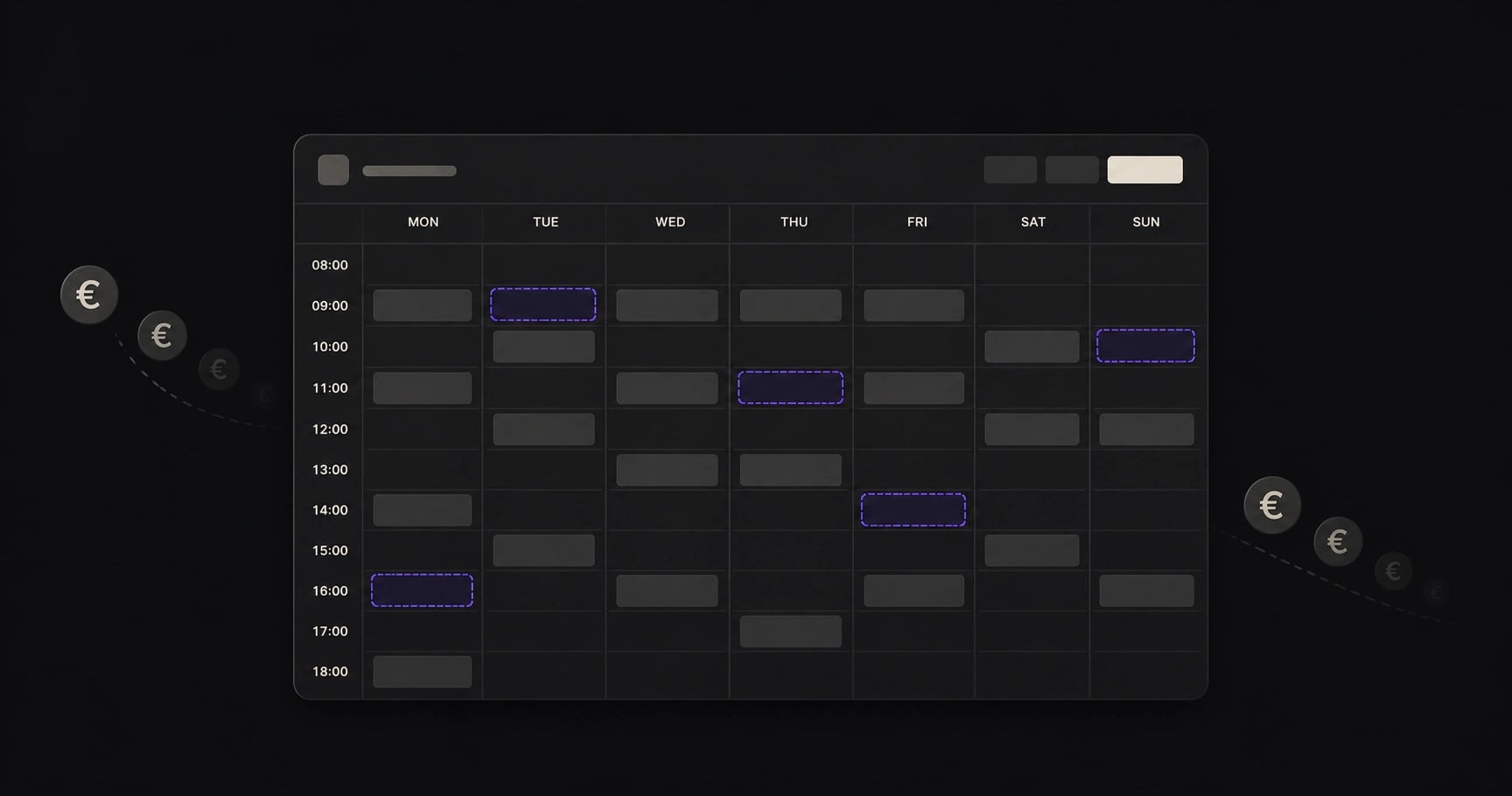
Why Service Businesses Lose Revenue Without Knowing It and How to Fix It
 ·25 April 2026
Why Service Businesses Lose Revenue Without Knowing It and How to Fix It
Most service businesses do not lose revenue in one dramatic moment.
They lose it quietly.
A missed appointment here. A client who forgets to reschedule. A deposit that was never collected. A booking request that came in after opening hours and was answered too late. A regular customer who never received a reminder to come back.
For salons, wellness studios, beauty businesses, consultants, fitness coaches, clinics, repair services, and local service providers in Luxembourg, these small gaps can become a serious revenue leak.
Stripe defines revenue leakage as expected income that a business loses through issues such as uncollected billing, under-pricing, or unrecovered costs. Stripe also cites EY's estimate that companies may lose up to 5% of earnings because of revenue leakage. (Stripe / EY)
The problem is simple: many business owners are busy serving clients, so they do not always see where money is slipping away.
This article explains why service businesses lose revenue without knowing it, where the hidden leaks usually happen, and how a better booking system can help fix them.
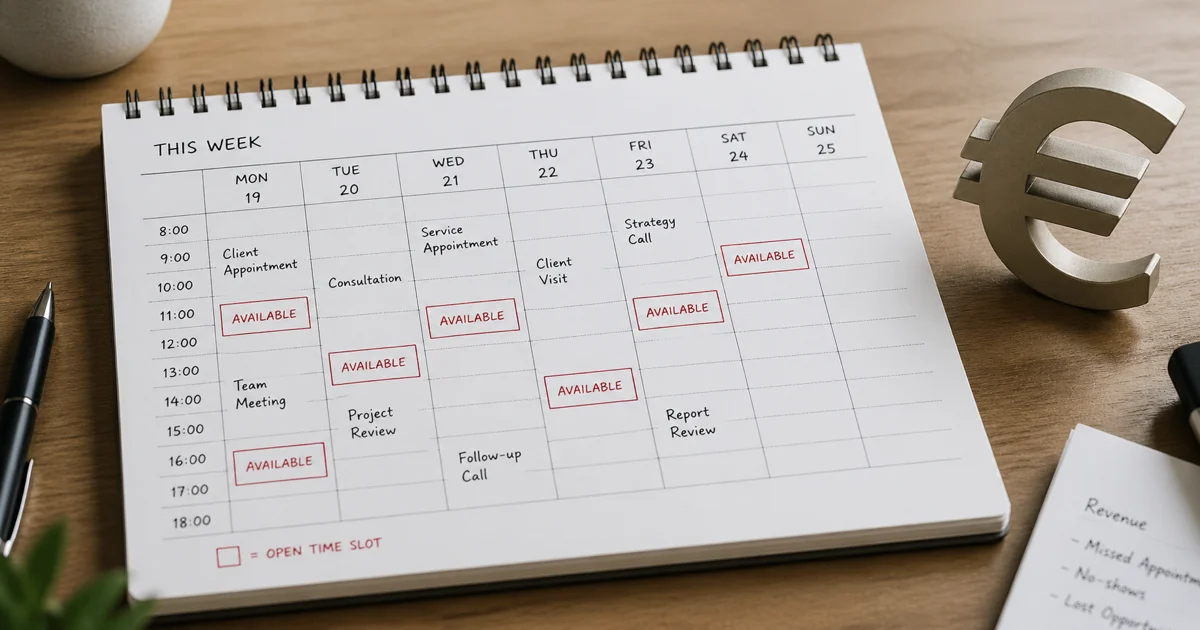
The Hidden Revenue Problem in Service Businesses
Service businesses depend on time.
Every appointment slot, consultation, table, class, treatment, or service window has value. Once that time passes, it cannot be sold again.
That is why revenue loss in a service business is different from revenue loss in retail. A product can often stay on the shelf and be sold tomorrow. But a missed 14:00 appointment is gone forever.
This creates a difficult situation for many small businesses: they may look fully booked on paper, but still lose money in practice.
A calendar can be full of appointments, but if clients cancel late, forget to show up, arrive unprepared, or never pay a deposit, the business still loses revenue.
The issue is not always demand. Often, the issue is operational leakage.
Why Service Businesses Lose Revenue Without Knowing It
No-Shows Turn Valuable Time Into Empty Slots
No-shows are one of the most visible forms of lost revenue, but many businesses still underestimate their real cost.
A no-show does not only mean one missing client. It can also mean lost service revenue, unused staff time, unused room or equipment capacity, missed product sales, lower daily productivity, and more pressure to overbook later.
In hospitality, payment provider Dojo found that 92% of businesses reported revenue loss from no-shows, with an average loss of £50 for every table of two that cancels. (Dojo, reported by Insider Media)
For appointment-based services, the numbers can also add up quickly.
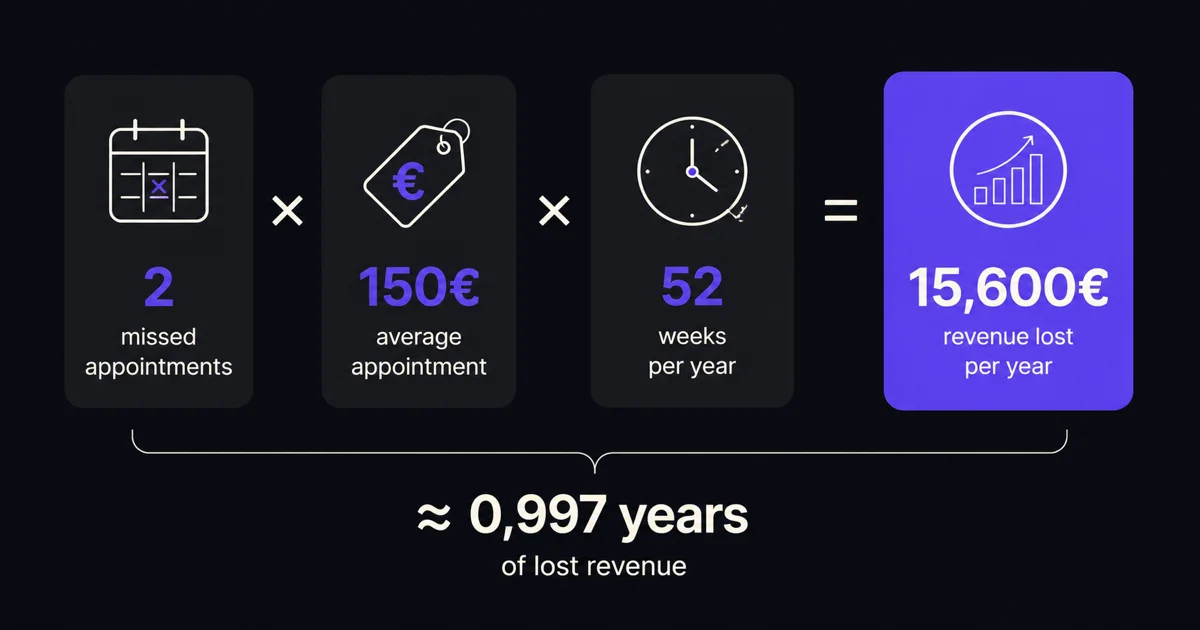
Imagine a salon, beauty studio, consultant, or wellness business loses just two appointments per week. If each missed appointment is worth €150:
2 missed appointments × €150 × 52 weeks = €15,600 per year
That is not a bad month. That is a yearly revenue leak.
This example is a calculation, not an industry benchmark. The exact number depends on the service price, cancellation rate, and ability to refill the slot.
Manual Reminders Are Easy to Forget
Many business owners still rely on manual reminders. A receptionist sends messages when there is time. The owner sends WhatsApp reminders in the evening. Some clients get a call. Others do not.
This works when the business is small and quiet. But once bookings increase, manual reminder systems become inconsistent.
Automated reminders are one of the simplest ways to reduce no-shows. A healthcare study found that patients who received SMS appointment reminders had no-show rates 38% lower than those who did not receive them. (Klara / Imperial College London, 2023)
Another 2025 study found that an automated SMS and telephone reminder system reduced no-shows from 18.55% to 7.01% in a healthcare context. (MDPI, 2025)
These studies are healthcare-focused, so the exact result may not apply to every service business. But the lesson is still useful: timely reminders help clients remember, confirm, cancel earlier, or reschedule.
For service businesses, that matters. Earlier cancellations give you a chance to refill the slot.
Late Cancellations Are Often Not Managed Properly
A no-show is obvious. A late cancellation can be more subtle.
The client cancels two hours before the appointment. The business accepts it politely. The slot stays empty. No deposit was collected. No cancellation fee applies.
The result is the same: lost revenue.
Many small businesses avoid cancellation policies because they do not want to appear strict. That is understandable. Client relationships matter.
But a clear cancellation policy does not need to feel aggressive. A good policy simply sets expectations:
- Please cancel at least 24 hours in advance
- Deposits may be required for selected services
- Late cancellations may result in a fee
- Clients can reschedule easily through the booking link
The goal is not to punish clients. The goal is to protect the business and keep the calendar reliable.
Businesses Miss Bookings Outside Opening Hours
Customers do not only make decisions during business hours.
Someone may want to book a haircut at 22:30. A client may remember during lunch break that they need a massage appointment. A busy parent may only have time to book after the kids are asleep. A tourist or expat in Luxembourg may prefer to book online instead of calling.
If your business only accepts bookings by phone, Instagram DM, or manual messages, you may lose clients simply because the booking process is too slow.
Eurostat reported that 23.8% of EU enterprises conducted online sales in 2023, up from 17.2% in 2013. While this includes more than appointment bookings, it reflects a wider shift toward online transactions and digital customer behaviour. (Eurostat, 2025)
For service businesses, online booking is part of that shift. A client who can book instantly is less likely to compare alternatives.
Weak Follow-Up Means Fewer Repeat Bookings
Many service businesses focus heavily on getting new clients. But repeat clients are often easier to convert than cold leads.
The problem is that follow-up is usually inconsistent.
A client comes in once. They enjoy the service. They leave. Then nothing happens. No reminder. No rebooking suggestion. No loyalty follow-up. No personalised offer. No birthday message. No "time for your next appointment?" notification.
HubSpot's CRM guidance highlights the importance of tracking customer relationships and interactions in one central place so businesses can manage follow-up more effectively. (HubSpot)
For a small service business, this does not need to be complicated. A basic CRM connected to your booking system can help you see who booked last month, who has not returned, who cancelled, who spends the most, and who should receive a reminder.
This is where booking software becomes more than a calendar. It becomes a revenue tool.
Deposits and Payments Are Not Collected Early Enough
Another common revenue leak is payment friction.
Some businesses only collect payment after the appointment. That can work, but it gives the business less protection against no-shows and late cancellations.
For higher-value appointments, deposits can help clients commit. Deposits are especially useful for long appointments, high-demand time slots, group bookings, premium services, services requiring preparation, first-time clients, and appointments outside standard hours.
Stripe's documentation explains that automated revenue recovery tools can help businesses reduce lost revenue from failed payments and missed conversions. (Stripe)
For service businesses, the same principle applies more broadly: the easier and earlier payment is handled, the fewer gaps appear later. A booking system with deposits or payment links can reduce awkward conversations and make the booking feel more professional.
How to Find Revenue Leaks in Your Own Business
Before fixing the problem, you need to see it clearly. Start with a simple revenue leak audit.
Track these numbers for one month:
- How many appointments were booked?
- How many clients did not show up?
- How many cancelled less than 24 hours before?
- How many empty slots could not be refilled?
- What was the average value of each missed slot?
- How many booking requests came through Instagram, WhatsApp, phone, email, and website?
- How many were answered too late?
- How many clients returned within 60 or 90 days?
This does not need to be perfect. Even a basic spreadsheet can show patterns.
But if the data lives across WhatsApp, paper notes, Instagram messages, Google Calendar, payment apps, and memory, it becomes hard to act on. That is why centralisation matters.
How Online Booking Software Fixes Revenue Leakage
A Better System Captures Demand Instantly
Online booking allows clients to book when they are ready. That means fewer missed calls, fewer forgotten messages, and fewer back-and-forth conversations.
For Luxembourg businesses serving multilingual clients, this can be especially helpful. A clear booking page can show services, prices, availability, language options, cancellation rules, and payment requirements before the client contacts you. This reduces friction for both sides.
Automated Reminders Reduce Forgotten Appointments
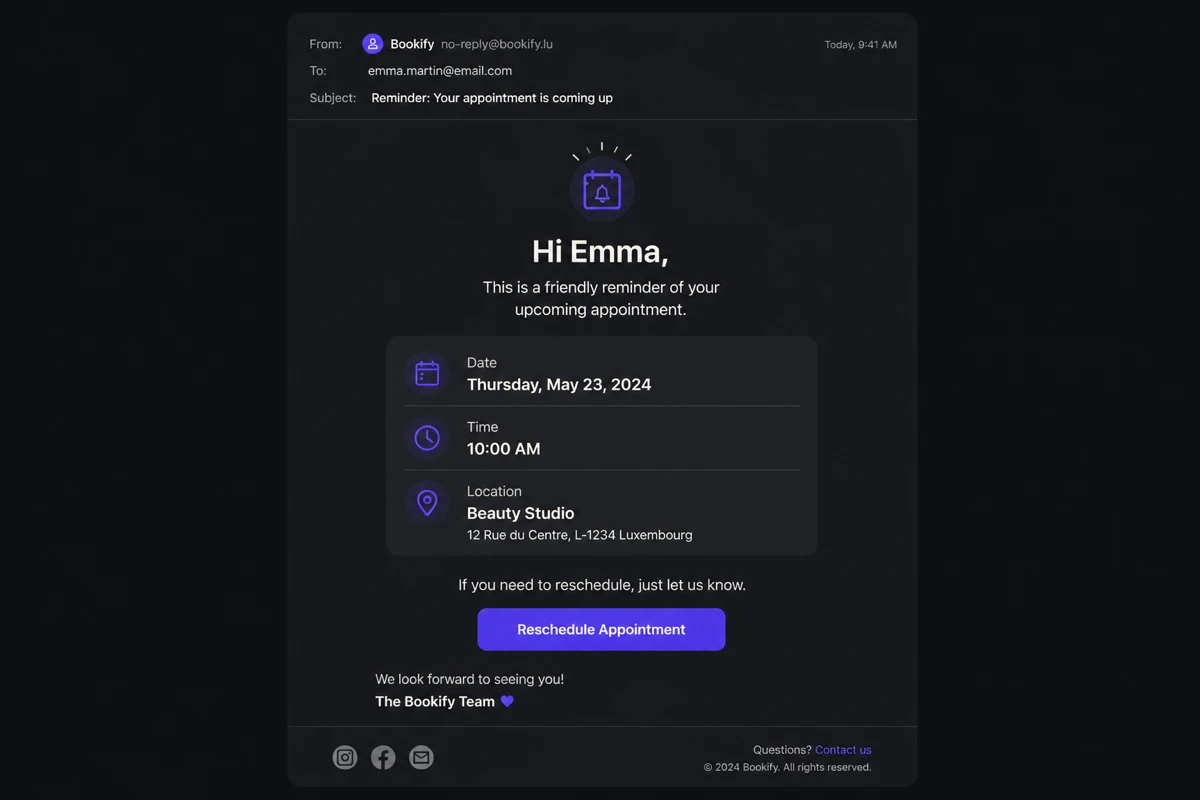
Automated reminders help clients remember their appointment without the business owner doing manual work.
A strong reminder setup usually includes confirmation after booking, a reminder 24 to 48 hours before the appointment, a same-day reminder for selected services, an easy cancellation or rescheduling option, and internal notifications for staff.
The reminder should be helpful, not annoying. For example: "Hi Sarah, this is a reminder for your appointment tomorrow at 14:00. Need to reschedule? Use this link."
Simple. Clear. Professional.
Deposits Protect High-Value Appointment Slots
Not every service needs a deposit. But for expensive, long, or high-risk appointments, deposits can protect the business.
A good booking system lets you choose when deposits are required. For example: no deposit for regular clients, 20% deposit for first-time clients, a fixed deposit for premium services, or full prepayment for workshops or classes.
This gives flexibility without making the entire customer experience feel strict.
CRM Helps Turn One-Time Clients Into Repeat Clients
A CRM is not only for large companies. For a local service business, a CRM can simply mean knowing who your clients are and when to contact them again.
A booking system with CRM features can help you create useful follow-up flows: a reminder after 6 to 8 weeks for hair salons, a follow-up after 30 days for massage studios, a check-in after project completion for consultants, a seasonal treatment recommendation for beauty salons, or a package renewal reminder for fitness coaches.
The goal is not spam. The goal is relevant, timely communication.
Reporting Shows What Is Actually Happening
Many business owners make decisions based on feeling. Reports help you see reality.
A good booking system should show monthly revenue, booking volume, no-show rate, cancellation rate, most booked services, best-performing staff, peak hours, repeat customer rate, and deposit and payment status.
Zenoti's reporting documentation shows how no-show and cancellation reports can list guests, service names, prices, discounts, and related invoices. (Zenoti)
For smaller businesses, the same idea matters: if you can measure the leak, you can reduce it.
Why This Matters for Luxembourg SMBs
Luxembourg is a digitally advanced market, but small business adoption still needs attention.
The European Commission's 2025 Digital Decade country report says Luxembourg remains a strategic digital hub with strong infrastructure, while still facing persistent challenges in SME digital uptake. (European Commission, 2025)
The Luxembourg government also supports digitalisation through SME Packages - Digital, which help eligible SMEs implement digital tools for better online communication with customers and improved business management. (Guichet.lu, 2025)
This is important for local service businesses. Customers are becoming more digital. Competition is becoming more professional. Manual systems are becoming harder to scale.
A business that still depends on phone calls, notebooks, scattered messages, and manual reminders may not notice the lost revenue immediately. But over time, the gap grows.
A Practical Revenue Leak Fixing Plan
You do not need to change everything at once. Start with the biggest leaks first.
Step 1: Calculate Your Missed Appointment Cost
Take your average service value. Then calculate: average service value × missed appointments per week × 52. This gives you a rough annual no-show cost. Even if the number is not perfect, it helps you understand the scale.
Step 2: Add Automated Reminders
Start with one reminder 24 hours before the appointment. Then test whether 48-hour reminders, same-day reminders, or confirmation requests improve results. Keep the message short.
Step 3: Add Deposits for Risky Bookings
Do not add deposits everywhere immediately. Start with long services, high-value appointments, new clients, weekend slots, and group bookings. This protects the most valuable calendar space first.
Step 4: Make Online Booking Easy
Your booking page should be simple. Clients should quickly understand what service they are booking, how much it costs, how long it takes, which time slots are available, what the cancellation policy is, and whether a deposit is required. If booking takes too many steps, clients may leave.
Step 5: Use CRM Follow-Ups
Create a small number of automated follow-ups. For example: "Time to book your next appointment?" or "Thank you for visiting." Keep it relevant and personal.
Step 6: Review Reports Every Month
Once a month, review no-shows, late cancellations, revenue by service, repeat clients, empty slots, new bookings, and payment status. This turns revenue protection into a habit.
Where Bookify Helps
Bookify is built for service businesses that want a cleaner, more reliable way to manage bookings.
Instead of using separate tools for appointments, reminders, deposits, CRM, and point of sale, Bookify brings the core workflow into one system.
That means business owners can accept online bookings, send automatic reminders, reduce no-shows, collect deposits, manage clients in a CRM, track revenue and appointments, and keep daily operations organised.
For a small business, this can remove hours of admin and make the customer experience feel more professional.
Try Bookify free for 30 days — no credit card required.
Conclusion: Revenue Loss Is Often a System Problem
Service businesses lose revenue without knowing it because the losses are small, scattered, and easy to ignore.
One missed appointment does not feel like a crisis. One forgotten follow-up does not feel urgent. One late cancellation does not seem worth analysing.
But together, these leaks reduce profit, waste time, and make growth harder.
The fix is not to work more hours. The fix is to build a better system.
With online booking software, automated reminders, deposits, CRM, and clear reporting, service businesses can protect their calendar, improve the client experience, and recover revenue that would otherwise disappear.
If your business still manages appointments manually, now is the right time to check what it may be costing you.
Start your free trial · Contact us
FAQ
Why do service businesses lose revenue without noticing?
Service businesses often lose revenue through small operational gaps: no-shows, late cancellations, missed calls, weak follow-up, uncollected deposits, and poor reporting. Each issue may seem small, but together they can create a significant revenue leak.
How much can no-shows cost a service business?
It depends on the average appointment value and how often clients miss appointments. For example, two missed appointments per week at €150 each equals €15,600 per year. This is a simple calculation, not a universal benchmark.
Do appointment reminders really reduce no-shows?
Research in healthcare settings has found that SMS reminders can reduce no-show rates. One study reported 38% lower no-show rates among patients who received text reminders. (Klara / Imperial College London, 2023). Results vary by industry, but reminders are a practical step for most appointment-based businesses.
Should small businesses require deposits?
Deposits are useful for high-value appointments, long services, first-time clients, group bookings, and peak-time slots. They do not need to be applied to every booking. A flexible deposit policy usually works best.
What is the best way to stop revenue leakage?
Start by tracking missed appointments, late cancellations, empty slots, and repeat bookings. Then add online booking, automated reminders, deposits, CRM follow-ups, and monthly reporting. The goal is to make revenue leaks visible and easier to control.
Is online booking software useful for Luxembourg businesses?
Yes. Luxembourg has strong digital infrastructure, but the European Commission still notes challenges in SME digital uptake. (European Commission, 2025). For local service businesses, online booking software can improve customer communication, reduce admin, and make operations more professional.
Sources & Further Reading
- Stripe — What is revenue leakage? Here's how to detect it and prevent it
- Stripe — Revenue recovery documentation
- Insider Media / Dojo — The impact of no-shows on small businesses
- Klara — Text appointment reminders reduce no-shows by 38%
- MDPI — SMS and Telephone Communication as Tools to Reduce No-Shows (2025)
- Zenoti — No-Show/Cancellation report documentation
- Eurostat — EU enterprises' online sales reach new heights in 2023
- European Commission — Luxembourg 2025 Digital Decade Country Report
- Guichet.lu — SME Packages - Digital